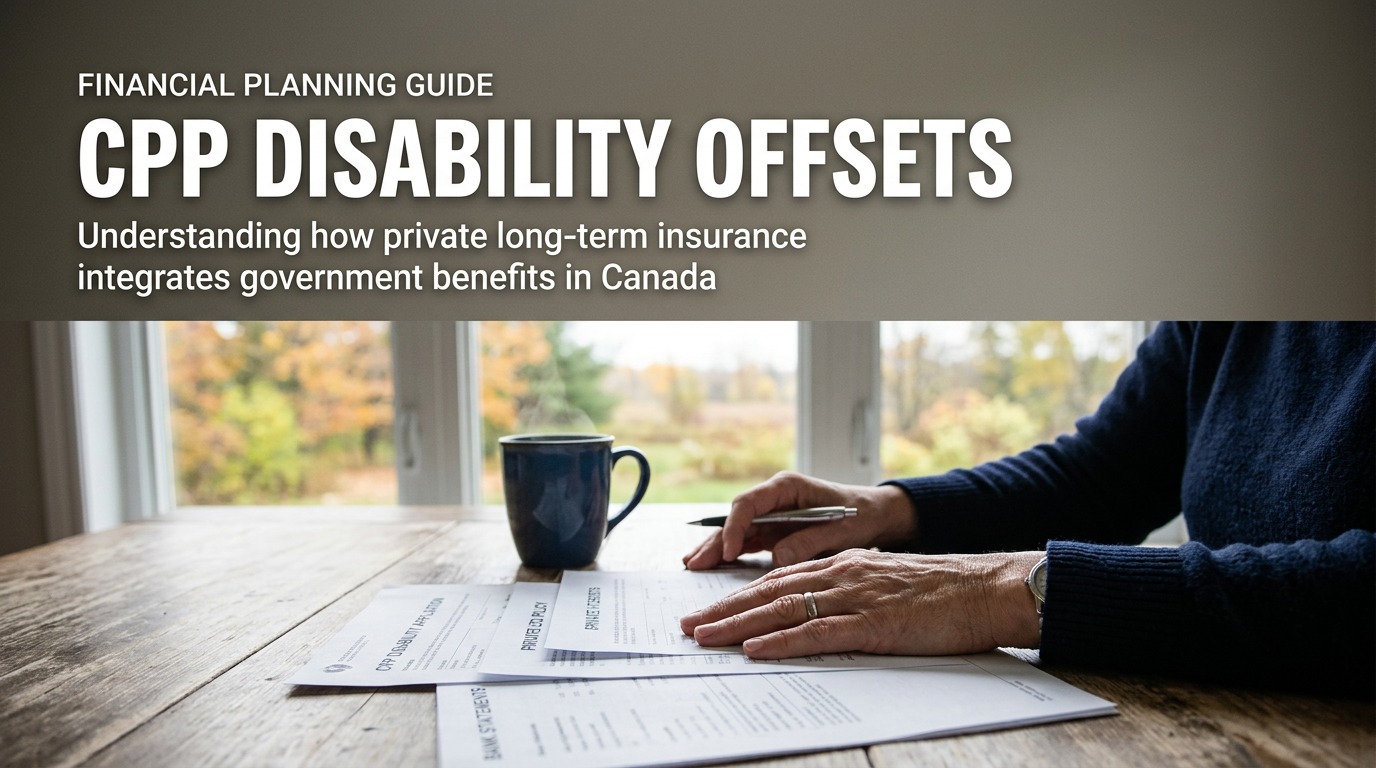
When a severe illness or injury prevents you from working, your private long-term insurance policy is meant to be a financial safety net. Yet, many Canadians experience a jarring shock when their monthly insurance deposit is suddenly reduced after government approvals come through. With the Canada Pension Plan (CPP) disability maximum sitting at $1,741.20 per month and the average sitting at $1,236.32 per month, understanding how private policies integrate these public funds is critical. If you hold an individual or group policy, knowing the rules around offsets prevents unexpected income shortfalls during an already stressful health crisis. For broader context on government disability initiatives, you can review our guide on the Canada Disability Benefit and DTC requirements.
What Is a Disability Insurance Offset and Why Does It Exist?
A disability insurance offset is a contractual provision that allows your private insurance company to reduce its monthly payout by the amount of other disability-related income you receive from public sources. Insurers include these clauses to prevent financial over-insurance, which occurs if collecting from multiple sources yields a total income higher than your pre-disability earnings. Insurance companies design private contracts to replace a specific percentage of your gross salary, typically between 60% and 70%. When government programs like CPP disability kick in, the insurer recalculates your total benefit to ensure you do not collect more than that contractual limit. While this rule protects insurers from moral hazard and escalating claims costs, it frequently blindsides policyholders who assumed their private contract summary guaranteed a fixed monthly dollar amount regardless of public assistance.
How Private Insurers Integrate CPP Disability Payouts
Integration is the mathematical mechanism insurers use to factor government benefits into your private claim payout. When you first go off work, your private insurer usually pays the full benefit outlined in your policy, minus any short-term disability or employment insurance (EI) sickness benefits you received initially. However, private contracts nearly always mandate that you apply for CPP disability benefits as soon as you meet their criteria for severe and prolonged disabilities. Once Service Canada approves your application, your private insurer adjusts your monthly payment. For instance, if your private policy promises a monthly benefit of $3,000, and your newly approved CPP disability payout is $1,236.32 per month (the average for July 2026), your private insurer will subtract the CPP amount from your private payment. Your new monthly breakdown will consist of $1,763.68 from your private insurer and $1,236.32 from CPP, maintaining your total monthly income at the contractual $3,000 threshold without exceeding it. For related financial planning guidance, consider how other government savings thresholds interact with your overall wealth, such as current RRSP contribution rules.
The "All-Source Maximum" Rule Explained
To fully comprehend benefit deductions, you must understand the all-source maximum rule. Most group and individual long-term disability policies contain a clause stating that the combination of all disability income from private, public, and sometimes even workplace pension sources cannot exceed a specified percentage of your pre-disability earnings, typically 80% to 85% of your gross pre-tax income. If your calculated all-source income exceeds this limit, the insurer reduces its private payout dollar-for-dollar until your total income falls below the ceiling. This integration ensures that working individuals do not have a financial incentive to remain on long-term disability rather than returning to active employment. Reviewing your policy wording with a specialized disability insurance broker can clarify what your specific all-source maximum percentage entails.
The Retroactive CPP Trap: What Happens When Backpay Arrives?
One of the most common points of friction between claimants and insurance companies involves retroactive CPP approvals. Because Service Canada can take several months or even over a year to process a disability application, you may receive your private insurance benefit without any offsets during the waiting period. When CPP finally approves your claim, they typically issue a large lump-sum backpay amount covering the months you were waiting. Private insurance companies include provisions in their contracts requiring you to reimburse them for the overpayments they made during that retroactive period. This means that when your CPP backpay arrives in your bank account, your insurance company will demand that you remit the portion corresponding to the offset period. Failing to budget for this repayment can lead to unexpected financial distress. To avoid spending this lump sum, claimants should set aside anticipated backpay funds until the formal adjustment is finalized by their insurer.
Checklist: Which Government Benefits Can Your Insurer Deduct?
- CPP or QPP Disability Base Payouts: Always deductible under standard Canadian private disability policies.
- CPP or QPP Children's Benefits: Policies vary, but many group plans and some individual contracts offset the additional amounts paid for dependent children.
- Workers Compensation Benefits (WCB/WSIB): Universally offset if the disability is work-related, as stacking WCB and private LTD is prohibited.
- Provincial Social Assistance or Disability Support: Frequently offset depending on provincial regulations and contract terms.
- Canada Pension Plan Retirement Pensions: Generally not offset if taken early at age 60, though rules differ once you reach age 65.
Frequently Asked Questions
Can my private disability benefit drop to zero if my CPP is high?
In most standard contracts, your private benefit will not drop below a specified minimum monthly amount, often set at $50 or 10% of the gross benefit, regardless of how high your government offsets calculate. However, your total combined payout will be heavily weighted toward the government portion.
Do I legally have to apply for CPP disability if my insurer tells me to?
Yes. Private insurance contracts include a cooperation clause that obligates you to apply for any government benefits for which you might be eligible. If you refuse to apply for CPP disability, the insurer has the contractual right to estimate what your CPP benefit would be and deduct that estimated amount from your private payout anyway.
How does the offset change when I turn 65?
Long-term disability benefits typically expire at age 65, aligning with the age when standard retirement pensions like CPP retirement and Old Age Security (OAS) begin. If your policy has a rider extending benefits past age 65, the offset rules change to integrate standard retirement pensions instead of disability benefits.
Are CPP children's benefits offset by private disability policies?
Whether CPP children's benefits are offset depends entirely on your specific policy wording. Many group policies include dependents' allowances in the all-source maximum calculation, meaning they will reduce your private payout further if you receive funds for your children, while some individual policies ignore family additions.
Disclaimer: This article is for informational purposes only and does not constitute financial or legal advice. Please speak to a licensed Insure4Me advisor for personalized recommendations.