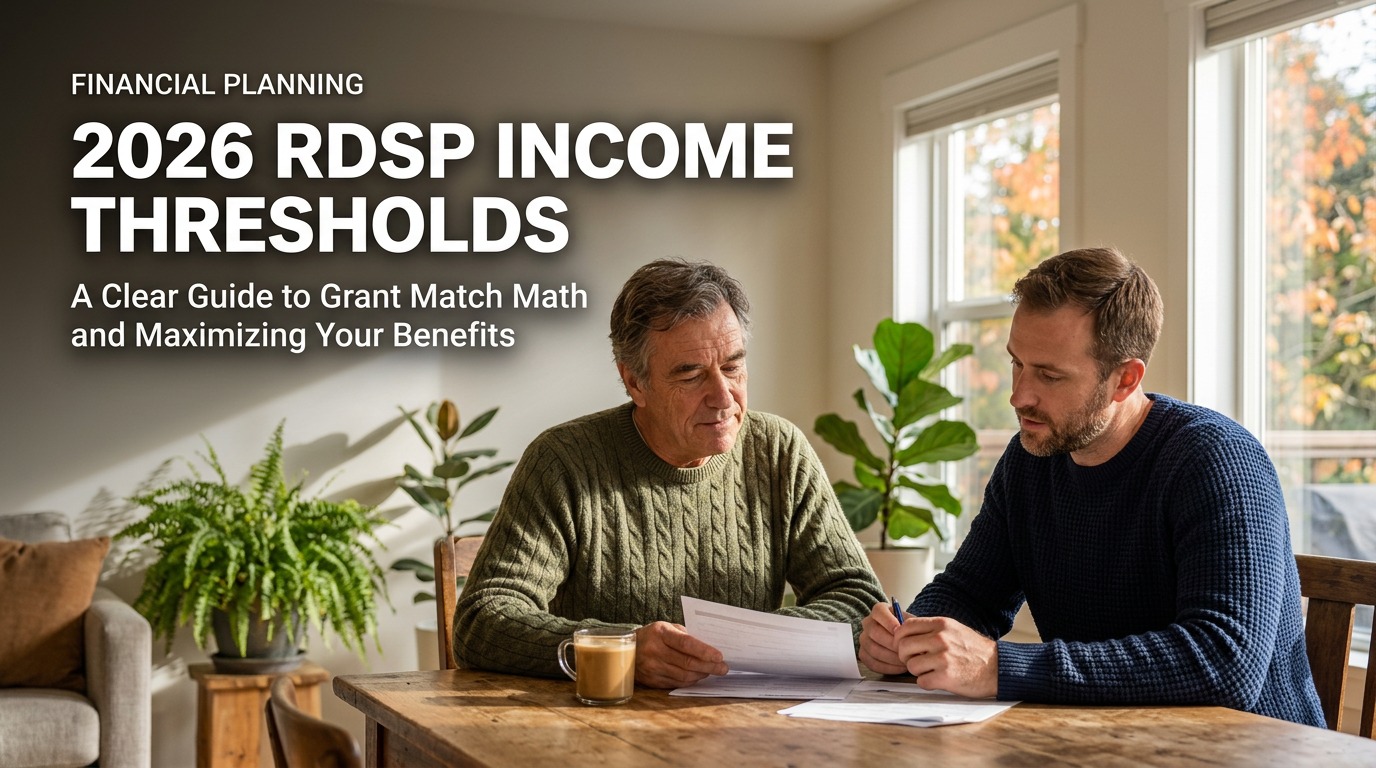
Maximizing a Registered Disability Savings Plan requires more than just making periodic deposits. For families and beneficiaries approved for the Disability Tax Credit, understanding how federal matching structures operate is critical to avoiding missed government funds. With official 2026 federal income matching thresholds fully active, the upper match tier cutoff sits at $117,045, while the Canada Disability Savings Bond phase-out ranges between $38,237 and $58,523. Generic bank portal pages frequently display these raw numbers without showing the precise contribution math required to secure every available dollar. If you want to build long-term financial security alongside other vital tools like disability insurance or critical illness insurance, you need a clear breakdown of how ESDC evaluates your family net income.
Understanding How 2026 RDSP Income Thresholds Work
The federal government uses family net income from two tax years prior to determine the matching rate for your Canada Disability Savings Grant. For contributions made throughout 2026, Employment and Social Development Canada evaluates your family net income from the 2024 tax year. For beneficiaries under the age of 18, this means the combined net income of the parents or legal guardians. Once the beneficiary reaches the year they turn 19, the calculation shifts exclusively to the individual net income of the adult beneficiary, plus the net income of their spouse if they are legally married or living in a common-law relationship.
This two-year lag often catches contributors off guard when their current earnings change significantly. However, it also provides stability, allowing you to review your historical tax filings ahead of time to calculate exactly how much matching power your account possesses. To align your registered savings strategy with other government programs, you can also explore related updates such as the insights shared in our guide on DTC approval requirements.
The 2026 Grant Matching Math: 300%, 200%, and 100% Tiers Explained
The Canada Disability Savings Grant is structured across two distinct income tiers, offering either a 300 percent or 200 percent match on your first contributions, followed by a 100 percent match on subsequent amounts. The dividing line for these tiers in 2026 is an inflation-adjusted family net income threshold of $117,045. If your family net income is at or below this second income threshold, you qualify for the most lucrative matching rates available.
For lower-income families where net income sits at or below $58,523 (adjusted annually), the government provides a staggering 300 percent match on the first $500 contributed each year. That means depositing $500 yields $1,500 in free federal grants. For contributions between $500 and $1,500, the government adds a 200 percent match, turning a $1,000 out-of-pocket deposit into $2,000 of grant money. Combined, depositing your first $1,500 yields a total of $3,500 in matching grants, hitting the annual maximum grant cap immediately.
If your family net income exceeds $58,523 but is below the $117,045 threshold, the matching structure shifts slightly. On the first $1,000 contributed annually, the government provides a 100 percent match, yielding $1,000. To reach the maximum annual grant ceiling of $3,500 under this tier, you must contribute out of pocket according to the specific progressive matching brackets, demonstrating why precise calculation prevents accidental under-funding.
Decoding the 2026 Bond Thresholds: Who Gets the $1,000 Without Contributing
While grants require out-of-pocket deposits, the Canada Disability Savings Bond provides direct financial support to lower-income Canadians without requiring any personal contribution. For 2026, the bond phase-out income range begins at $38,237 and ends at $58,523. If your family net income is $38,237 or less, the beneficiary is eligible to receive the full annual bond of $1,000, up to a lifetime maximum of $20,000.
When family net income falls within the phase-out range between $38,237 and $58,523, the bond amount is gradually reduced on a sliding scale until it reaches zero at the upper limit. Families in this bracket should verify their notices of assessment carefully. Securing these funds is a crucial component of holistic planning, much like reviewing comprehensive financial safeguards through our RDSP program overview and related advisory services at our contact page.
Step-by-Step Contribution Strategy to Hit the $3,500 Maximum Grant
Strategic depositors do not simply drop a lump sum into an account without checking their annual caps and matching tiers. Because the lifetime contribution limit stands at $200,000 and the lifetime maximum grant limit is capped at $70,000, timing your deposits maximizes every available dollar. If you qualify for the lower income tier, depositing precisely $1,500 out of pocket each calendar year unlocks the absolute maximum $3,500 annual grant. Depositing more than $1,500 in that tier will not attract additional matching funds for that year, meaning excess capital could be deployed more efficiently elsewhere.
For contributors in the higher tier (family net income above $117,045), the government provides a flat 100 percent match on the first $1,000 contributed annually. To reach higher grant totals in this bracket, individuals must utilize carry-forward provisions from previous years when they were eligible but failed to contribute. By calculating your unused grant room from up to 10 years prior, you can catch up on missed matching funds, provided the beneficiary is under the age of 49.
Frequently Asked Questions About 2026 RDSP Rules
Which tax year's income determines my 2026 grant match?
ESDC uses your family net income from two tax years prior to calculate your matching tier for the current calendar year. Therefore, contributions made throughout 2026 are evaluated based on your family net income reported on your 2024 tax returns.
What happens to my RDSP grants after age 49?
Canada Disability Savings Grants and Bonds can be paid into an RDSP through December 31 of the calendar year in which the beneficiary turns 49. Once the beneficiary turns 50, new government grants and bonds stop, but existing funds continue to grow tax-deferred.
Can I catch up on missed grants using carry-forward rules?
Yes. You can carry forward unused grant and bond entitlements for up to 10 preceding years, provided the beneficiary had an active RDSP or was eligible for the Disability Tax Credit during those years. Catch-up contributions are matched starting with the oldest eligible year.
How do personal contributions affect my taxable income?
Contributions made to an RDSP are made with after-tax dollars and are not tax-deductible. However, all investment growth inside the plan accumulates tax-free until withdrawal, at which point the grant, bond, and earnings portions are taxed as income in the hands of the beneficiary.
Disclaimer: This article is for informational purposes only and does not constitute financial or legal advice. Please speak to a licensed Insure4Me advisor for personalized recommendations.