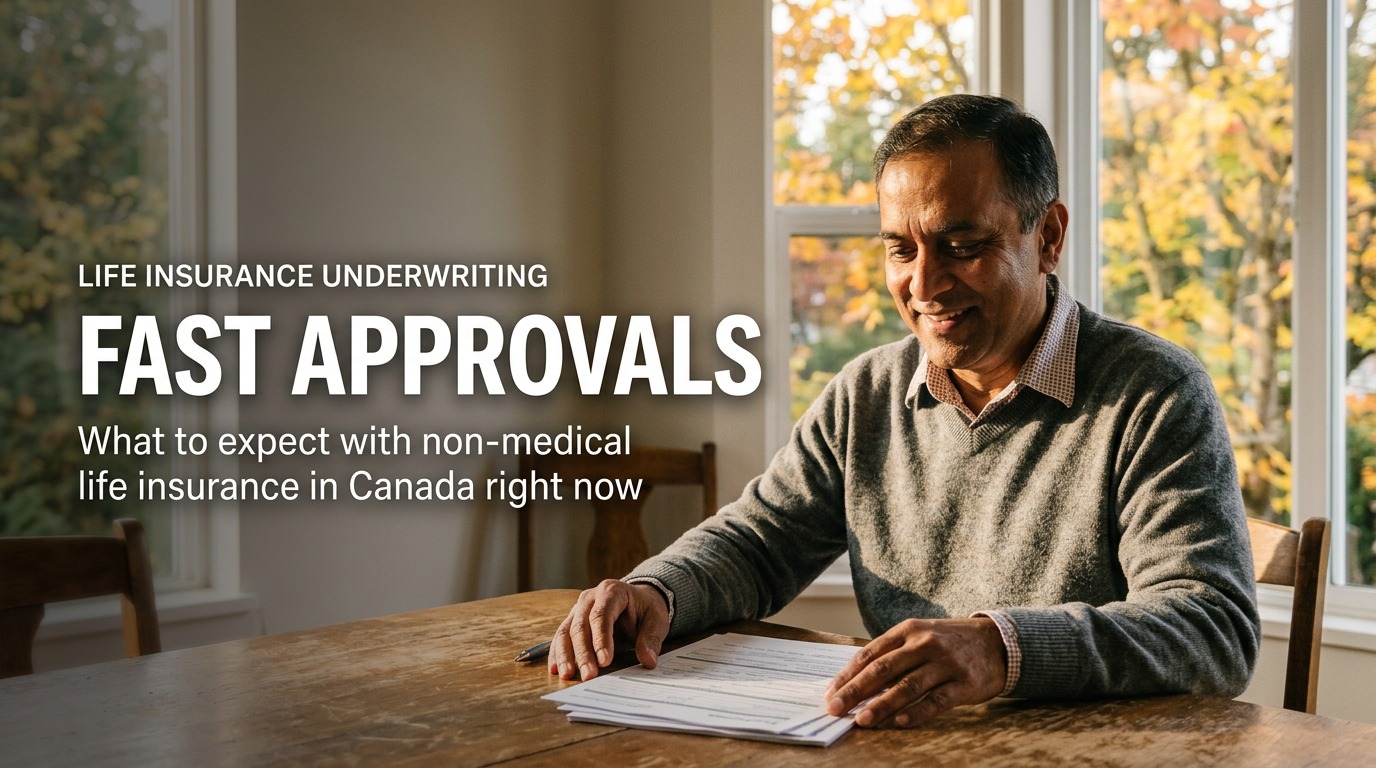

For years, shopping for a substantial life insurance policy meant bracing for a lengthy, intrusive ordeal. A healthy 38-year-old professional looking for a $1.5M term policy could expect to wait up to a month, schedule a nurse visit for blood work and urine samples, and wait anxiously for a medical records request from their family doctor. Fortunately, the Canadian insurance landscape has shifted dramatically. Major carriers like BMO and Manulife have scaled up automated and accelerated underwriting pathways, redefining what fast-track coverage looks like.
If you are planning your financial portfolio, you might also look at other long-term wealth instruments such as the 2026 RRSP contribution limit Canada to maximize your tax shelters while securing your family's financial future. Protecting your income and loved ones no longer requires jumping through old-school bureaucratic hoops if you maintain a clean health profile.
What Is Accelerated Life Insurance Underwriting in Canada?
Accelerated life insurance underwriting is a digital evaluation process that uses predictive algorithms, electronic data verification, and smart questionnaires to evaluate risk instantly. Instead of demanding traditional medical exams for every applicant, Canadian life insurers rely on massive electronic databases, Motor Vehicle Records (MVR), Medical Information Bureau (MIB) databases, and prescription fill histories to verify your background.
This approach differs fundamentally from old-school non-medical insurance, which typically targets higher-risk or older individuals with simplified issue questions and higher baseline pricing. Accelerated underwriting is designed for healthy, standard-to-preferred risk applicants who want standard or preferred pricing tiers without the weeks of waiting.
How 2026 AI and Digital Underwriting Changed the Timeline
Life underwriting and pricing emerged as the most popular category for artificial intelligence adoption among life insurers in early 2026, recording dozens of operational use cases across the country. Carriers introduced adaptive questioning algorithms that dynamically alter follow-up questions based on your previous answers. According to industry reports from mid-2026, Manulife's adaptive questions feature doubled instant approval rates and cut unnecessary medical questions by up to 40 percent.
Furthermore, the launch of advanced AI underwriting assistants in late 2026 replaced static PDF manuals with real-time risk assessment tools. What used to take 28 days of back-and-forth communication between brokers, underwriters, and medical offices now takes mere minutes for qualifying applicants.
Current Coverage Limits: When You Can Skip Vitals and Fluids
One of the most exciting developments for Canadian consumers is the dramatic expansion of no-exam face value limits. While carriers historically capped accelerated programs at modest amounts like $250,000 or $500,000, market pressures pushed limits significantly higher. BMO notably scaled its accelerated underwriting limits up to $5 million, making high-net-worth protection vastly more accessible.
For our target 38-year-old buyer looking for a $1.5M term policy, this means you fall squarely within the sweet spot for automated approval. As long as your digital footprint and self-reported health declarations remain clean, you can bypass the needle and scale straight to binder issuance.
The Hidden Checkpoints: What Canadian Insurers Screen Behind the Scenes
Skipping a medical exam does not mean skipping scrutiny. When you submit a digital life insurance application, automated background systems perform instant checks across several key Canadian data repositories. Understanding these checks helps demystify how insurers evaluate risk without a doctor present.
- Medical Information Bureau (MIB): Checks if you have previously applied for coverage with other insurers and whether any medical flags were raised.
- Prescription Databases: Insurers review digital pharmacy networks (such as Telus Health/PharmaNet checks in applicable provinces) to verify your prescription fill history over the past three to five years.
- Motor Vehicle Records: Algorithms check your driving history for excessive speeding, DUIs, or reckless driving infractions.
- Financial and Identity Verification: Instant checks confirm your identity, employment stability, and general financial risk profile.
Checklist: What Automatically Disqualifies You From Accelerated Approval?
While digital systems are fast, they operate on strict algorithmic tripwires. If your profile hits any of these pre-set exclusions, your application is automatically rerouted to traditional manual underwriting, triggering a request for a nurse visit, blood work, or an Attending Physician Statement (APS).
- Age or coverage amount exceeding the carrier specific accelerated maximum (e.g., applying for over $5M or outside eligible age brackets like 18-50).
- Recent history of tobacco or heavy nicotine use not disclosed or falling outside non-smoker guidelines.
- Frequent prescription fills for chronic conditions such as unmanaged diabetes, severe cardiovascular disorders, or active cancer treatments.
- A driving record featuring major infractions or multiple recent speeding tickets.
- Dangerous occupational hazards or extreme unlisted hobbies like skydiving or rock climbing.
FAQ: Real Questions Canadians Are Asking About Fast-Track Life Insurance
Can I get approved for a $1M term policy today without seeing a doctor?
Yes. With major Canadian life insurers pushing accelerated underwriting limits up to $5 million, a healthy applicant in their 30s or 40s seeking a $1M or $1.5M term policy can routinely complete the process digitally and receive approval within minutes or hours, assuming no hidden health flags appear during background checks.
Do digital life insurance applications check my prescription history?
Yes, absolutely. With your electronic consent, insurers run secure queries against Canadian pharmacy databases. If you take routine maintenance medications for minor conditions, it may not disqualify you, but discrepancies between your self-reported health answers and your actual prescription fill history will immediately trigger a manual review.
What happens if my digital application gets flagged for manual underwriting?
A flag does not mean a denial. It simply means the automated rules engine could not make an instant decision. The file moves to a human underwriter who may request standard additional information, such as a quick paramedical nurse visit for blood pressure and blood work. Your application proceeds just like a traditional fully underwritten policy from that point.
Are non-medical or accelerated policies more expensive than traditional fully underwritten policies?
For accelerated underwriting programs offered by major traditional carriers (like BMO or Manulife), pricing is identical to fully underwritten policies if you qualify. However, simplified issue or standalone non-medical policies aimed at higher-risk or older individuals do carry higher premium rates because the insurer assumes more statistical risk without medical documentation.
Disclaimer: This article is for informational purposes only and does not constitute financial or legal advice. Please speak to a licensed Insure4Me advisor for personalized recommendations.