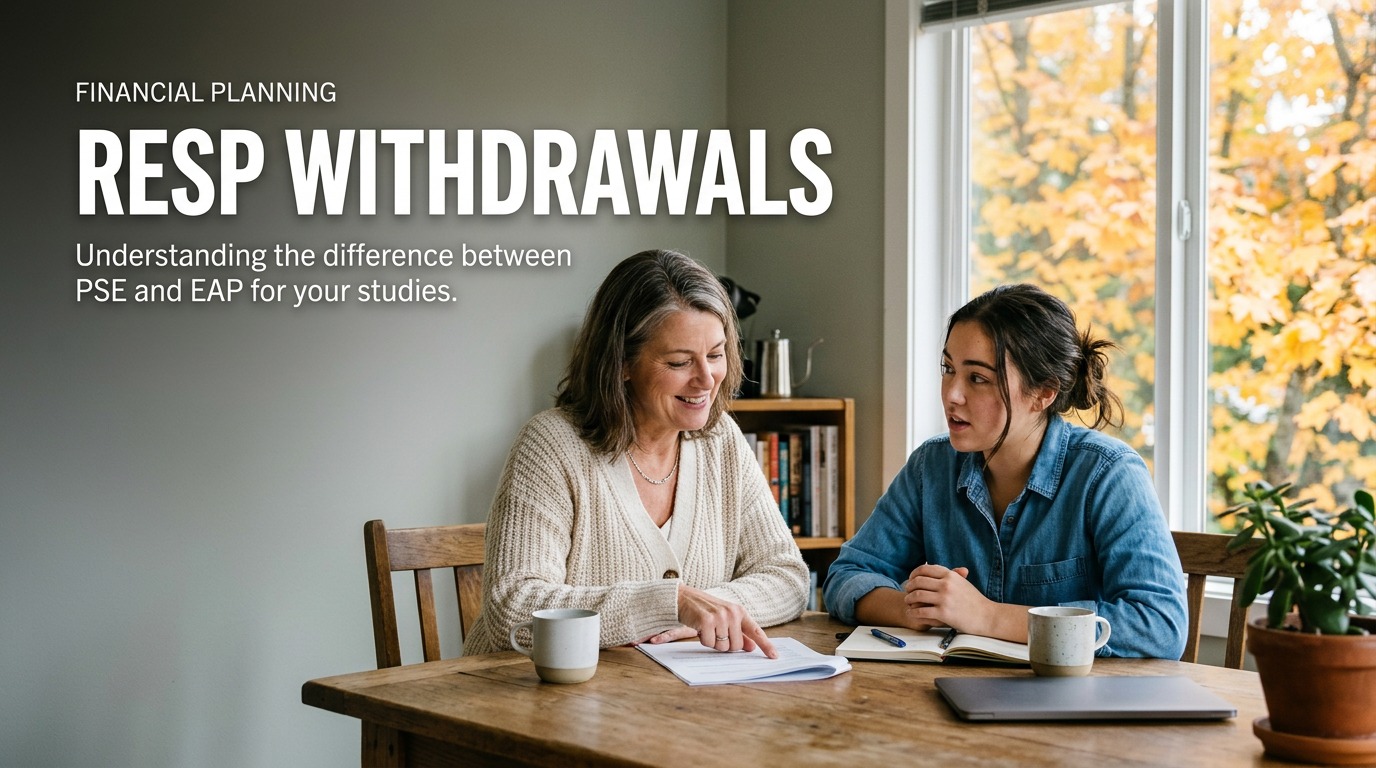
As post-secondary students settle into their second semester or prepare for upcoming academic terms, parents and students frequently confuse how money is pulled from a Registered Education Savings Plan. While generic guides explain how to open an account or how the basic Canada Education Savings Grant works, real Canadians run into heavy friction at withdrawal time. Many families are shocked to discover that not all dollars coming out of an RESP are treated equally by the Canada Revenue Agency. Distinguishing between tax-free contributions and taxable Educational Assistance Payments is essential to avoiding unexpected tax bills, hitting administrative caps, or disrupting your child's financial stability.
The Two Buckets Inside Every RESP (Contributions vs. Grants & Growth)
To understand how RESP withdrawals work, you must look at the account as a container holding two distinct financial buckets. The first bucket consists of your original contributions, which represent the exact after-tax dollars you deposited over the years. Because you already paid income tax on those earnings when you earned them, withdrawing them incurs zero additional tax liability. The second bucket consists of government incentives—such as the basic Canada Education Savings Grant, additional CESG, the Canada Learning Bond—and all accumulated investment growth inside the portfolio. Whenever you need deeper guidance on optimizing these funding streams alongside your broader financial goals, our dedicated RESP planning hub provides comprehensive strategies.
Many families fail to realize that withdrawing money requires strict tracking of which bucket funds are pulled from. If you want to understand how previous contribution pacing impacts your overall strategy, review our insights on catching up on RESP contributions and CESG to ensure you maximize government matching before your student reaches the age limit. Mismanaging these buckets can lead to unexpected tax consequences or administrative roadblocks at the financial institution when tuition invoices arrive.
What is a PSE Withdrawal? (Your Tax-Free Contributions)
A Post-Secondary Education withdrawal represents the return of your original contributions. According to current ESDC statistical data, PSE withdrawals are drawn strictly from original subscriber deposits and are completely excluded from EAPs. Because you contributed after-tax dollars, taking out PSE funds returns money directly to the subscriber or the student tax-free. There are no federal limits or thresholds on how much PSE money you can withdraw at once, provided the student is actively enrolled in a qualifying educational program. If your child's tuition and living expenses for the first semester are extraordinarily high, pulling from the PSE bucket allows you to cover large capital expenses without triggering any taxable income for the student.
What is an EAP? (Taxable Grants, Bonds, and Investment Growth)
Unlike PSE withdrawals, an Educational Assistance Payment consists entirely of the government grants, bonds, and investment earnings accumulated inside the RESP. When an EAP is issued to a student, the money is treated as taxable income in the hands of the student for the calendar year in which it is withdrawn. Because students often have little to no other taxable income during their studies, they can frequently withdraw these funds with minimal or zero actual tax payable due to their personal basic personal amount and tuition tax credits. However, financial institutions are legally required to issue a T4A slip for EAP withdrawals, making it vital to coordinate these distributions carefully.
The 13-Week Rule: Navigating the Full-Time EAP Limit ($8,000 Cap)
One of the most common points of friction for parents is attempting to withdraw a large lump sum of EAP funds for first-semester tuition and dorm fees, only to be told by the bank that a strict limit applies. Under CRA Bulletin No.1R3, the annual threshold or limit for EAP withdrawals during full-time studies is set at $8,000 for the first 13 consecutive weeks of the program. For part-time studies, the annual threshold is capped at $4,000. If your student is enrolled in a specialized program with exceptionally high upfront costs during those initial weeks, you cannot simply drain the entire grant and growth bucket at once unless specific criteria are met or special permission is granted by the promoter after the initial 13-week window passes.
Comparison Table: PSE Withdrawals vs. Educational Assistance Payments (EAPs)
To clarify the exact mechanical differences between the two withdrawal types, review the summary breakdown below:
- Source of Funds: PSE comes from original subscriber contributions; EAP comes from CESG, CLB, and investment growth.
- Tax Treatment: PSE is completely tax-free; EAP is taxable income for the student.
- Withdrawal Limits: PSE has no federal limits; EAP is capped at $8,000 for the first 13 weeks of full-time studies.
- Recipient: PSE can be paid to the subscriber or the student; EAP must be paid to or for the benefit of the student.
- Proof of Enrolment: Both require proof of enrolment, but EAPs have stricter compliance tracking by financial institutions.
Frequently Asked Questions
Who actually pays the tax on an EAP withdrawal—the parent or the student?
The student pays the tax on any EAP withdrawal. Because students typically earn modest incomes while studying, their individual tax brackets are usually low or zero, resulting in little to no tax owed. For broader retirement and savings considerations that might impact your household cash flow, many parents also review tools like our guide on the latest RRSP contribution limits to ensure a balanced overall household financial strategy.
Can I withdraw more than the $8,000 EAP limit if my first-semester tuition is higher?
During the first 13 consecutive weeks of a full-time program, the $8,000 cap is strictly enforced by financial institutions per CRA guidelines. However, you can supplement your cash flow needs by withdrawing from your tax-free PSE contribution bucket to cover any remaining tuition or living expenses without hitting the EAP threshold. Once the initial 13-week period has elapsed, higher EAP amounts can typically be requested depending on the plan promoter's administrative rules.
What happens to the unused RESP money if my child decides not to go to college or university?
If your child decides against post-secondary education, your original contributions (PSE) can be withdrawn tax-free. Government grants (CESG and CLB) must be returned to the government. Accumulated investment earnings can sometimes be transferred into your RRSP if you have available contribution room, or withdrawn as Accumulated Income Payments, which are subject to regular income tax plus an additional 20% penalty tax.
How do I prove enrolment to my financial institution to release an EAP?
You will need to submit an official confirmation of enrolment or a signed form from the designated educational institution proving that the student is registered in a qualifying educational program. This document must show the student's name, the name of the school, the program start and end dates, and whether the student is enrolled full-time or part-time.
Disclaimer: This article is for informational purposes only and does not constitute financial or legal advice. Please speak to a licensed Insure4Me advisor for personalized recommendations.